The operating system for AI-native product building
The next role in software isn’t PM or Engineer. It’s ProductBuilder.
AI is compressing implementation cost, shifting value toward specification, judgment, and operational ownership. ProductBuildersHQ develops the frameworks, standards, and tools that help people and organizations make that transition — from AI-assisted work to autonomous product delivery.
- Frameworks
- 10 Frameworks
- Case Studies
- 5 Case Studies
- Papers
- 14 Papers
- Autonomy Levels
- 7 Autonomy Levels
Start Here
One system, four entrances
The boundary between Product Manager and Engineer is dissolving. This is the system for what comes next — enter as a person leveling up, a team transforming delivery, a spec author, or an operator running the tools.
The Person
Become a Product Builder
Climb from Observer to Product Builder — the maturity model for the person, grounded in the LEVER capability framework.
The Team
Make Delivery Autonomous
Move your team up the seven autonomy levels — from AI-assisted coding to autonomous operations — and keep the result maintainable with SCALE.
The Method
Write Specs Agents Can Execute
AWS Working Backwards, PR/FAQ, and the 6-Pager — the narrative discipline other spec-driven systems skip.
Learn more →The Tools
Operate the System
VisionStudio — author and evaluate specs with LLM-as-a-Judge, then track execution across initiatives, phases, and roadmap items.
Learn more →The Operating Model
Two loops, one system
The Product Loop originates what to build and verifies it worked. The Builder Loop implements it and verifies it’s built right. Same anatomy — intent, AI drafts, human gate, AI executes, verify — different artifacts and verification questions.
When building is cheap, only results are scarce.
Gates shift from human to policy authority as a team climbs the autonomy levels. Single-loop systems — AWS AI-DLC, GitHub Spec-Kit, OpenSpec — map onto the Builder Loop; see the SDD Catalog.
The Foundational Models
Two ladders, one destination
One model for the person — how a PM or Engineer becomes a Product Builder. One model for the process — how a team climbs from AI-assisted coding to autonomous operations.
Product Builder Maturity Model
Read the framework →Two on-ramps, one destination: PMs and Engineers take different paths through Levels 3–4, then converge at Level 5 — the Product Builder.
Software Delivery Autonomy Levels
Read the framework →Levels 4–7 are the frontier — and the case studies below are already there. Each yellow chip is a published deep dive, placed at the level the organization operates.
In Action
From spec to shipped
Author specs with Working Backwards discipline, judge them with LLM-as-a-Judge, then track execution across initiatives, phases, and roadmap items.
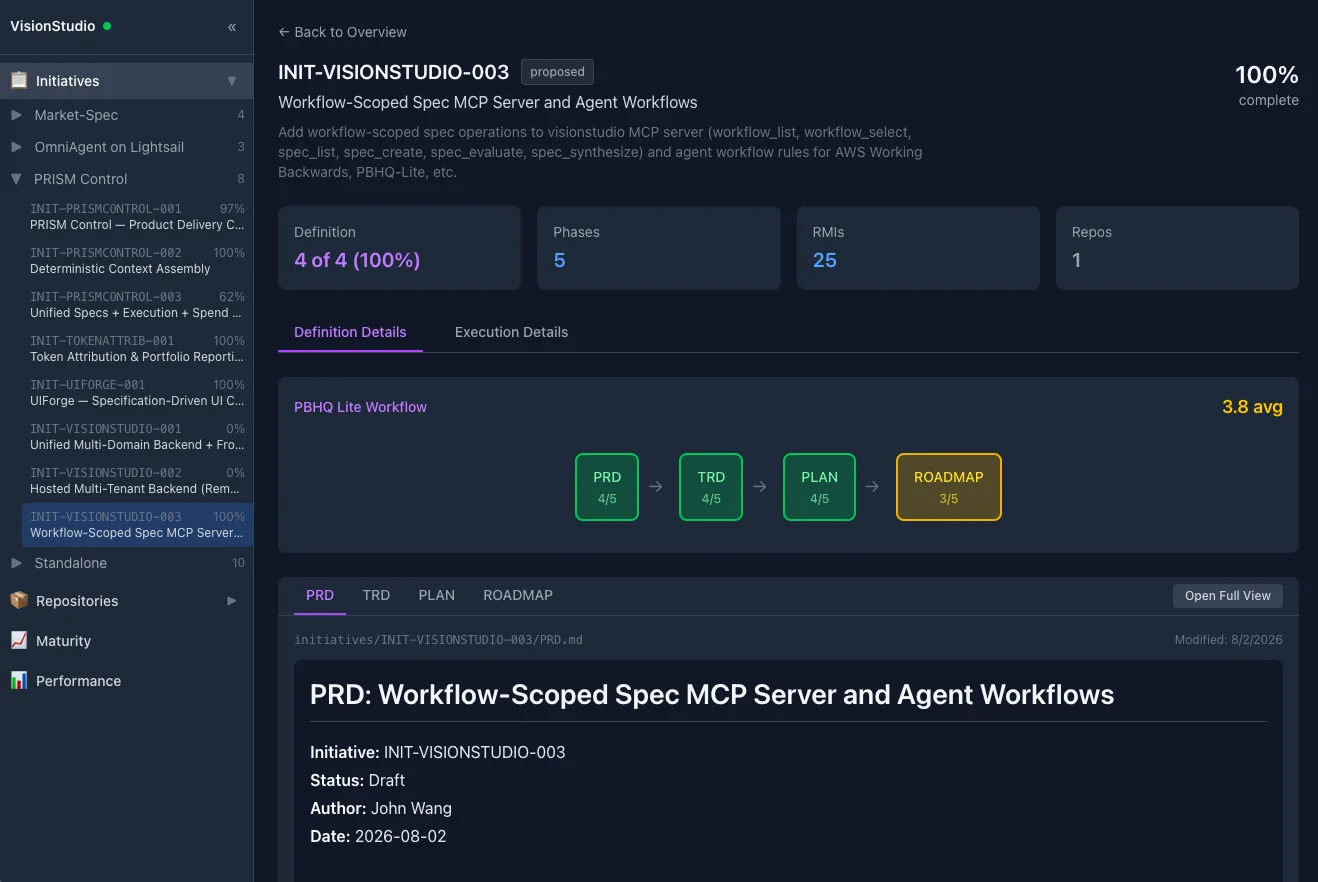
Specs
Each initiative is a chain of specs — PRD, TRD, PLAN, ROADMAP — every stage judged in place with a categorical LLM-as-a-Judge score, so the weakest link is obvious.
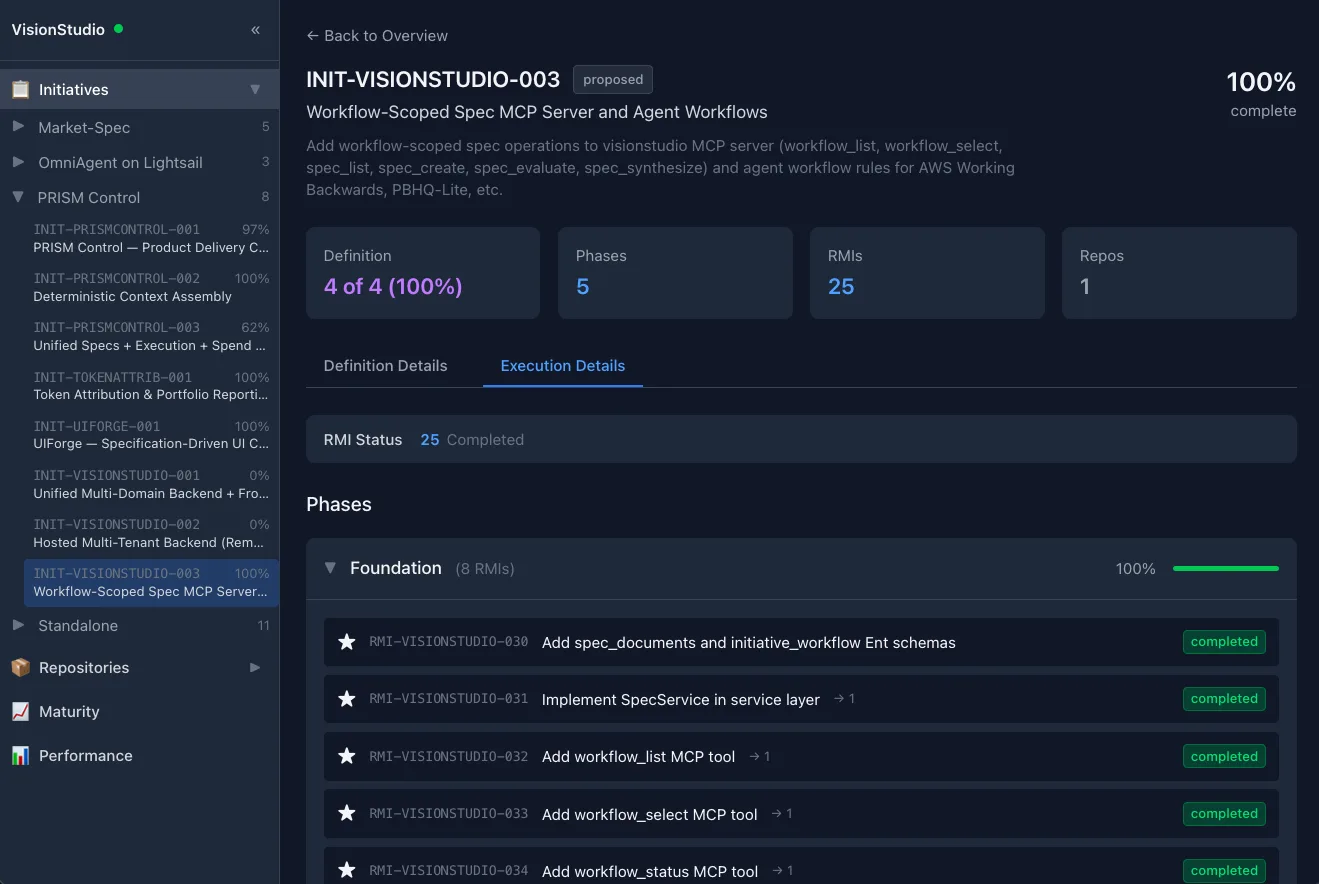
Execution
From spec to shipped — roadmap items (RMIs) tracked in phases, each with completion status and dependencies, so progress is visible down to the individual item.
Library
Frameworks
Maturity models for product builders
The Product Loop & Builder Loop
AI-DLC, Spec-Kit, and OpenSpec run a single engineering loop: the task arrives from outside, and verification means the code matches the task. The two-loop model adds the missing Product Loop — originating what to build and verifying it worked — the same move Scrum@Scale made for Scrum.
Product Builder Maturity Model
A maturity model defining growth toward independent product ownership, with paths for both Product Managers and Engineers converging at the Product Builder level.
Software Delivery Autonomy Levels
A seven-level progression from traditional Agile teams to autonomous software delivery and operations, introducing ASDM for autonomous coding, review, validation, and operations.
The Five Ps
When building is cheap, only results are scarce. The Five Ps stage a product from Preparation to Profit, and answer the question the maturity models don't: not how good are you, but how far did the product get.
AI-Native Product Manager Metrics
Input and output metrics for AI-Native Product Managers focused on customer request velocity. How to measure PM effectiveness when the goal is shrinking delivery time from years to 30 days.
The App Reality Ladder
A five-rung claim-strength ladder for AI-era software artifacts. When AI makes everything look real, the label on an app must say what it proves — not what it resembles.
DORA and SPACE in the AI Age
How traditional software delivery and developer productivity frameworks must adapt for AI-assisted development. Introducing AI-DORA and AI-SPACE: modified metrics for the era of AI product builders.
LLM-as-a-Judge
A practitioner's guide to replacing human code review with LLM-based evaluation, multi-judge aggregation, and VEAL loop integration for continuous validation.
Loop Engineering
A practitioner's guide to designing self-running AI coding agents with Claude Code, Codex CLI, and the REAL/VEAL loop patterns for production multi-agent systems.
Spec-Driven Development
A comprehensive guide to spec-driven development (SDD) methodologies and tools for AI coding agents, including GitHub SpecKit, AWS Kiro, AI-DLC Workflows, OpenSpec, and VisionSpec.
In Practice
Case Studies
Real-world implementations of AI-native development, each mapped to its autonomy level
Project Mantle: AI-First Development at AWS
AWS
A deep dive into AWS's Project Mantle, where nine senior engineers used AI-first development practices to build a new inference engine with dramatically increased commit velocity.
Cursor by Anysphere
Anysphere
How Cursor pioneered vibe coding, grew to 1M+ daily active users, and navigates the tension between free-form AI coding and spec-driven development.
GitHub Copilot Workspace
GitHub / Microsoft
How GitHub Copilot Workspace evolved from experimental browser-based IDE to the foundation of Copilot's agentic capabilities, introducing spec-driven workflows to mainstream development.
Spotify Honk
Spotify
How Spotify built Honk, their background coding agent that has merged 1,500+ pull requests into production using Claude Code, constraint-based design, and years of platform infrastructure investment.
StrongDM Software Factory
StrongDM
How StrongDM's Software Factory removes humans from coding and code review, replacing review with scenario-based validation and Digital Twin testing.
From the Field
Signals
Industry evidence that the transition is underway — lighter than case studies, mapped to the frameworks
Andrew Ng: Engineers Should Learn Product. PMs Should Learn to Code.
Andrew Ng — Founder, DeepLearning.AI
Andrew Ng argues that AI-accelerated coding shifts the bottleneck from engineering to deciding what to build — collapsing engineer-to-PM ratios and favoring generalists. His observations map directly onto the PBMM ladder.
Jack Dorsey: Block Replaces the Org Chart With Three Roles
Jack Dorsey — Block (CEO)
Block is normalizing to three roles — ICs, DRIs, and player-coaches — with a shared world model replacing the middle-management layer that used to route information. Their DRI is ProductBuildersHQ's one human operator, and their world model is the platform that makes one accountable owner viable.
Boris Cherny: "Coding Is Solved," and Engineering Merges Into Product Building
Boris Cherny — Creator and head of Claude Code, Anthropic
Boris Cherny says coding is practically solved and that engineering roles will merge into generalist product builders — the ProductBuildersHQ thesis, from the person who built the tool doing the solving. But 'solved' quietly assumes you can still govern the output, which reframes the two paths to Product Builder.
Ready to evolve your product development?
Download our frameworks and start your journey from AI-assisted to AI-operated.
Get Started →